

I once saw a LinkedIn post from an advisor that had nothing to do with market volatility or tax codes. He shared a short, raw story about helping a client navigate the financial side of a sudden family loss. It wasn’t “content” in the traditional sense; it was a demonstration of empathy backed by 30 years of expertise. That single post did more for his authority than a hundred generic market updates ever could. It proved the core truth of the industry: people don’t just hire your math; they hire your judgment and your voice.
Key Highlights
-
Strategic Guidance: Discover how sales funnels and landing pages move visitors through a deliberate, planned process.
-
Conversion Focus: Learn why landing pages with clear goals capture more potential clients than standard websites.
-
The Buyer’s Journey: Understand the progression from awareness to a long-term partnership.
-
Implementation Steps: A five-step guide to building your first funnel using the right tools and data.
Introduction
Financial advisors who want to do well in today’s digital world need to use sales funnels and landing pages. These tools help with lead generation and guide website visitors through a planned process. A good landing page with clear goals can grab the attention of potential clients and encourage them to act. A well-organized sales funnel helps them move smoothly to the final action. This article shares the methods, tools, and strategies that financial advisors can use to turn simple clicks into long-term, valuable clients.
Understanding Landing Pages and Sales Funnels
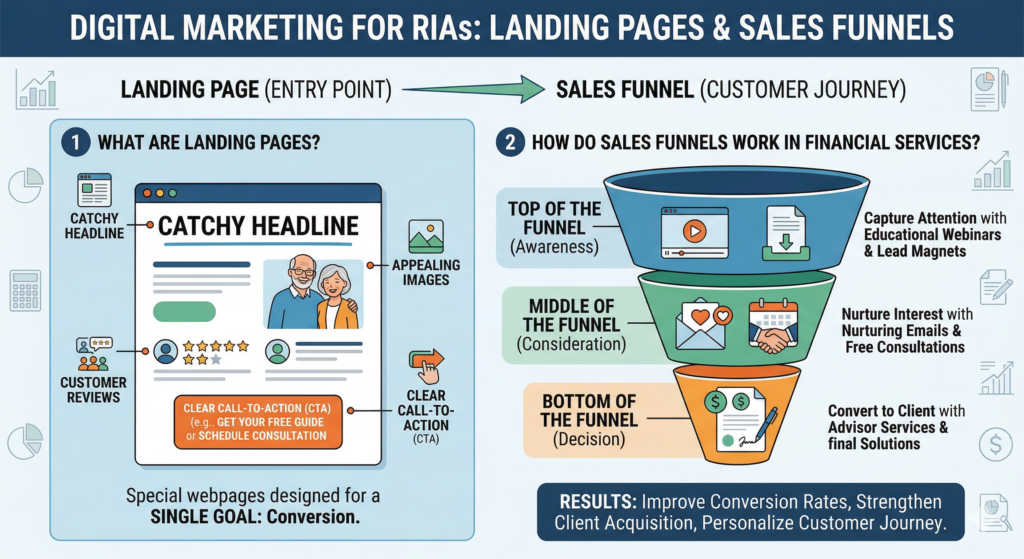
For financial advisors, understanding how landing pages and sales funnels work together is very important for their digital marketing for RIAs comprehensive handbook efforts. Landing pages are where visitors begin. They motivate people to take action. Sales funnels then help these potential clients move through a series of steps towards becoming a customer.
These tools make sure that each website visitor receives relevant information and can easily move through the customer journey. By using this method, financial advisors can improve their conversion rates and strengthen their client acquisition strategies.
What are Landing Pages?
In the world of digital marketing, landing pages are special web pages made for one goal: getting people to convert. Unlike regular websites for financial advisors that do many things, these pages zero in on a specific marketing strategy, like getting contact information or sharing a lead magnet.
The power of landing pages is that they help boost conversion rates. They cut down on distractions and focus all attention on one clear call-to-action (CTA), like signing up for a newsletter or scheduling a meeting. For example, a financial advisor might make a page that offers a free guide on retirement planning, prompting visitors to give their email address. Using catchy headlines, customer reviews, and appealing images all help create a strong page.
How Do Sales Funnels Work in Financial Services?
A sales funnel is a clear way to help potential clients move from learning about services to becoming a client. It starts with a well-planned customer journey, focusing on different pain points at each step:
-
Top of the Funnel: Educational webinars and lead magnets grab attention.
-
Middle of the Funnel: Nurturing emails or free consultations keep them interested.
-
Bottom of the Funnel: Advisors offer their services as the final solution.
The Role of Landing Pages in a Sales Funnel
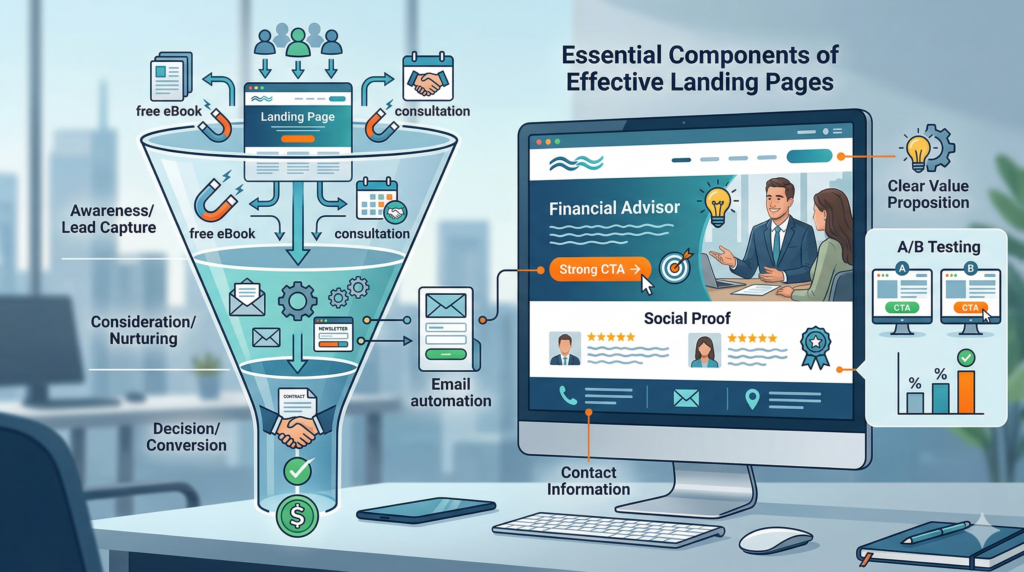
Landing pages act as the first point of contact. Located at the top of the funnel, these pages grab attention using a lead magnet, like a free eBook or consultation. A good landing page helps guide prospects to their next step, which could be signing up for a newsletter or setting up an appointment.
Also, a well-structured landing page works well with email automation systems. This lets advisors nurture leads over time. By focusing on one specific action, these pages reduce distractions and improve the conversion rate. This sets the stage for client acquisition.
Essential Components of Effective Landing Pages
The success of a landing page depends on how it looks and works. It should clearly show its value proposition and inspire people to take action quickly.
Key Elements Every Page Must Have
-
Clear Value Proposition: Show how your services address customer pain points.
-
Strong Call-To-Action (CTA): Short, clear prompts like “Schedule Your Consultation.”
-
Social Proof: Testimonials and case studies from current clients to build trust.
-
Professional Design: Easy-to-read layouts with clear visuals that match your brand.
-
Contact Information: Visible phone numbers or email addresses for quick contact.
Design Principles for Maximum Conversion
Designing for higher conversion rates is about improving the user experience. Simple layouts, clear branding for financial services, and short messages help keep visitors interested. Make navigation easy by staying away from clutter and using whitespace well.
A/B testing is a great way to improve your designs. Try different layouts, images, and the placement of CTAs to see what works best with your audience.
Building Your First Sales Funnel
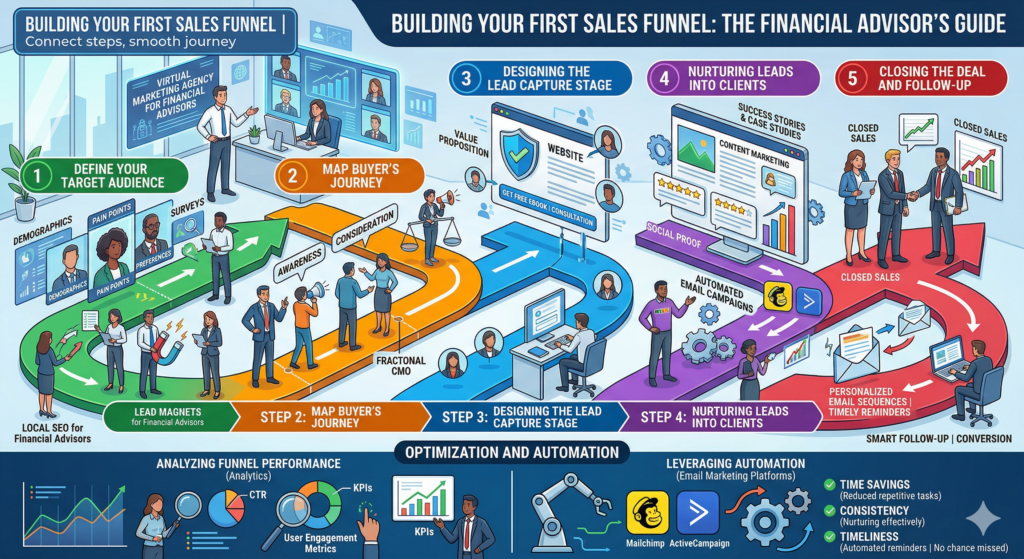
Creating your first funnel can help grow your business. Connecting all the steps—from bringing in traffic to closing sales—helps create a smooth customer journey. Partnering with a virtual marketing agency for financial advisors can make this process even more seamless.
Step 1: Define Your Target Audience
Focus on key demographics, pain points, and preferences. You can collect contact information through surveys or lead magnets. This may involve specific strategies like local SEO for financial advisors to identify who you want to reach.
Step 2: Map Out the Buyer’s Journey
Understand the stages potential clients go through: awareness, consideration, and decision-making. At this stage, some advisors utilize the expertise of a fractional CMO for financial advisors to ensure their strategy meets the specific needs of their audience.
Step 3: Designing the Lead Capture Stage
Offer a clear value proposition with an interesting lead magnet (free ebook or consultation). Keep forms simple, asking only for essential contact information to increase completion rates.
Step 4: Nurturing Leads into Clients
Give content marketing for financial advisors a central role here. Use targeted email marketing campaigns and automation tools to provide valuable information that fits their financial goals. Sharing success stories and case studies builds social proof and boosts trustworthiness.
Step 5: Closing the Deal and Follow-up
Combine smart follow-up and a clear value proposition. Use personalized email sequences or timely reminders to increase your conversion rates and build long-lasting connections.
Optimization and Automation
Analyzing Funnel Performance
Tracking performance using analytics is very important. Focusing on key performance indicators, like click-through rates and user engagement metrics, helps you make decisions based on data.
Leveraging Automation
Automation tools help organize email marketing for financial advisors. Platforms like Mailchimp and Active Campaign help create easy-to-manage email sequences.
-
Time Savings: Reduces repetitive tasks and manual work.
-
Consistency: Leads are nurtured effectively without extra effort.
-
Timeliness: Automated reminders and follow-ups ensure no chance is missed.
Case Studies and Insights
Case Study 1: Transforming Leads into High-Value Clients
A firm created special landing pages offering free consultations. They used effective email marketing to tailored messages to solve client pain points. By sharing helpful social proof, the firm boosted its conversion rates and expanded its client base.
Case Study 2: Effective Use of Webinars
One firm used webinars to show their expertise and saw a 30% boost in lead generation. They invited attendees to set up free consultations, engaging potential clients and helping with conversions in the next stage of the journey.
Common Pitfalls and How to Avoid Them
-
Overcomplicating the Process: Simplicity is vital. Confusing messages cause potential clients to leave.
-
Ignoring Mobile Optimization: Many visitors use mobile devices. Frustrating mobile experiences lower engagement.
-
Inadequate Follow-Up: Use automated reminders and personal outreach to ensure leads do not go cold.
Conclusion
The journey from getting a click to gaining a client depends on a strong sales funnel and landing pages. When advisors know how to get leads and make each step better, they can greatly improve their conversion rates. Using these strategies can create a stronger client base, increase customer lifetime value, and help both advisors and clients reach financial freedom.
Frequently Asked Questions
How Often Should I Revise My Sales Funnel?
Review your sales funnel every three months. Look at how well things are working, test different ideas, and listen to what clients say.
What are the Cost Implications of Building a Sales Funnel?
Costs include software subscriptions, design tools, and marketing expenses. Knowing these expenses helps advisors use their resources better.
Can Sales Funnels Work for All Types of Financial Services?
Yes. Sales funnels can be adjusted for wealth management, insurance, and tax advice by personalizing strategies to meet the specific needs of clients.
How Do I Measure the Success of My Landing Page?
Keep an eye on conversion rates, bounce rates, and time on page. Use analytics tools to watch how visitors act and understand what content and design changes are needed.
What are common mistakes to avoid?
Avoid over-cluttering with information, ignoring mobile-friendliness, and failing to have clear calls-to-action.
Midstream Marketing is the growth partner for independent financial advisors, providing strategy-led, compliance-aware marketing services designed to drive predictable leads and long-term firm growth.
