Websites for Financial Advisors

Professional, High-Converting Websites for Financial Advisors

We'll create a custom website that sets you apart as a financial advisor and turns visitors into booked appointments.

If your website:
Time for a Big Change.

Your website should attract, engage, and convert visitors into loyal clients by delivering a seamless and compelling online experience.

Designed for Financial Advisors.

We craft bespoke websites tailored to your industry, ensuring maximum impact by boosting credibility, engagement, and client conversions.

Maximize Your Online Impact.

A strategic website not only attracts visitors but also compels them to take actions, boosting engagement and appointment.

Establish Authority Build trust.
Stand out as the go-to financial advisor in your market by building trust, credibility and lasting client relationships.

Here's How We Do it

We identify your prospects’ needs, analyze competitors, and highlight your firm’s unique value. Then, we craft a compelling website that drives visitors to inquire about your services instantly.
Understanding-Your-Prospects
Understanding Your Prospects

Your website should speak directly to the financial concerns that keep your ideal clients up at night — from uncertainty about retirement to frustration with poor investment advice. We dig deep to uncover what your prospects truly value: clarity, trust, and peace of mind. By aligning your message with their goals and challenges, we help you build an emotional connection that turns visitors into engaged prospects ready to take the next step.

Showcasing-Your-Unique-Value
Analyzing the
Competition

Most advisory firms have a website that looks and sounds exactly like everyone else’s — and prospects can’t tell the difference. We analyze competing firms in your market to identify overused messaging, weak positioning, and design trends that fail to convert. Then we strategically craft your site to stand out — emphasizing your distinct approach, your credentials, and the specific transformation clients experience when working with you.

Showcasing-Your-Unique-Value
Showcasing Your Unique Value

Every financial advisor has a story — but few tell it well online. We help you define and communicate your unique value proposition with clarity and confidence. Whether it’s your tax-smart investment process, fiduciary independence, or hands-on client experience, we translate your strengths into persuasive website copy and visuals that earn trust and make your firm memorable. The result: a brand that differentiates you and a message that compels prospects to act.

Building-a-High-Converting-Website
Building a High-Converting Website

A beautiful design isn’t enough. Your website must move visitors from curiosity to commitment. We combine conversion psychology, StoryBrand messaging, and data-driven design principles to create an experience that guides users toward scheduling a consultation. From SEO optimization to clear calls-to-action, every element is engineered to increase inquiries, boost engagement, and help you win more clients — automatically.

Here's what else you'll get

Beyond a stunning design, your website will be optimized for AUM. With SEO, your site will rank higher, making it easier for your ideal prospects to find you. Our responsive design ensures a seamless experience across all devices, keeping visitors engaged. Plus, our expert copywriting captivates, persuades, and compels visitors to take action—turning interest into booked appointments.
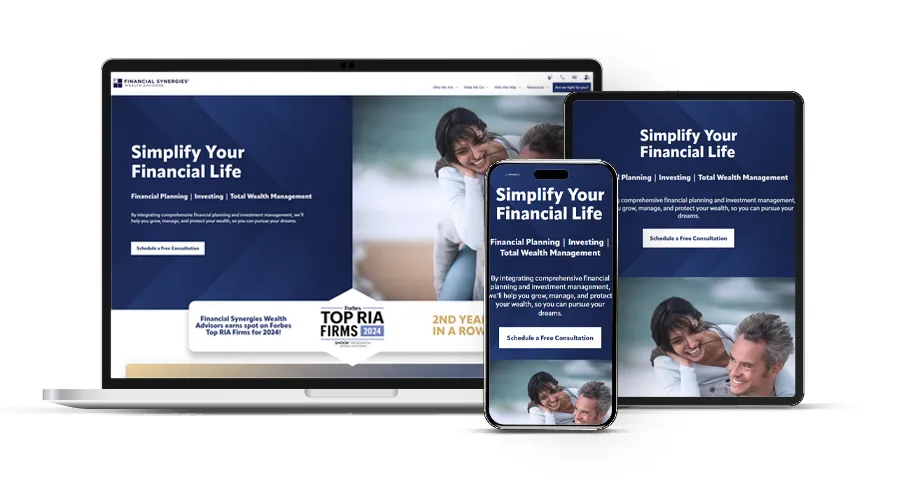
Devices
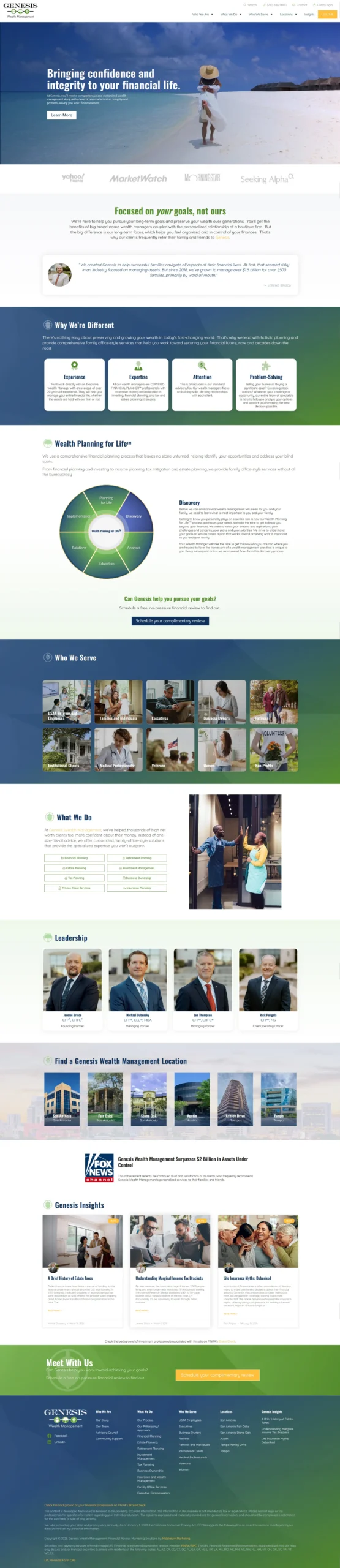
Genesis

Take a Quick Look at Some of Our Work

Your website is more than just an online presence—it’s a powerful tool to attract, engage, and convert potential clients. A well-designed, high-converting website can position you as an authority, build trust, and drive meaningful engagement with your audience. That’s why we create websites specifically tailored for financial advisors, ensuring they are not only visually appealing but also strategically crafted to generate results.

From professional, sleek designs to compelling, conversion-focused content, every element is carefully developed to reflect your brand’s unique value. We combine SEO optimization, responsive design, and persuasive copywriting to ensure your website works for you 24/7, bringing in qualified leads and turning visitors into booked appointments.

So, if you’re looking for a website that is not only well-written and engaging but also fully compliant with industry regulations, you’re in the right place. Our goal is to help you stand out in a competitive market, attract the right clients, and grow your business with confidence.

Take a look at some of our past work and see firsthand how we’ve helped other financial advisors build strong online presences. If you’re ready to elevate your brand and generate more booked appointments, we’d love to create a high-converting website for you too!
If you want a uniquely designed website that serves as a powerful tool to enhance your online presence, build trust with prospects, differentiate yourself in a competitive market and ultimately… gets you more booked appointments, THEN let’s talk.

Schedule a Call Here

How to Make Your Financial Advisor Websites Stand Out

Key Highlights

  • Client-focused copy that uses “you” more than “we” immediately signals empathy and builds trust.
  • Interactive tools like quizzes and risk assessments improve engagement and lead generation.
  • Niche positioning strengthens authority and helps advisors attract their ideal clients.
  • Clean design and authentic imagery establish credibility and professionalism.
  • Social proof (testimonials, certifications, awards) validates expertise.
  • Educational content (blogs, eBooks, guides) builds authority and drives organic growth.

Introduction

Your website isn’t just a digital brochure — it’s your firm’s front door. For financial advisors, that first digital impression often determines whether a visitor becomes a client. Research from the Pew Research Center¹ shows that over 90% of Americans conduct online research before making important financial decisions.

That means your website is doing the talking long before you do.

A top-performing financial advisor website must accomplish three key things:

  • Show empathy — focus on client needs and goals, not firm achievements.
  • Build authority — share actionable, educational insights that demonstrate expertise.
  • Create clarity — deliver a seamless, intuitive experience that builds confidence.

As confirmed by the Nielsen Norman Group², users form opinions about a website’s trustworthiness within 50 milliseconds of landing on a page. A great financial advisor site isn’t just visually appealing — it’s client-centric, compliant, and built to convert.


Understanding What Makes a Financial Advisor Website Stand Out

A truly standout financial website isn’t about you — it’s about them. Visitors want reassurance that you understand their goals and can help them achieve financial confidence. That’s why the best advisor sites speak directly to clients using “you” language instead of “we.”

According to the Harvard Business Review³, businesses that use client-centered copy build 43% stronger emotional trust compared to those that focus on their own achievements.

When a prospective client lands on your website, they’re subconsciously asking:

  • “Can this advisor help someone like me?”
  • “Do they understand my financial situation?”
  • “Do I trust them enough to reach out?”

A website that immediately answers these questions creates instant trust momentum.
The American Marketing Association⁴ found that aligning tone and message with client empathy increases engagement metrics by over 40% in professional services industries.

To achieve this, every page should follow a clear structure:

Who you serve → What you offer → Why you’re the right fit → How to start.

By simplifying your site’s narrative, you allow visitors to see themselves in your story — and that’s what converts interest into inquiries.


Current Trends in Financial Advisor Websites (2024)

Financial advisor websites in 2024 are evolving beyond static service pages into dynamic, educational experiences. The best-performing firms combine technology, personalization, and storytelling to engage clients.

Insights from Think with Google⁵ and the HubSpot State of Marketing Report⁶ reveal that interactive content and tailored user experiences can increase session duration by 200–300% and conversion rates by up to 45%.


Key 2024 Website Trends for Financial Advisors

  • Interactive Quizzes: Gather lead data while educating users (e.g., “What’s Your Retirement Readiness Score?”).
  • Dynamic Videos: Short, authentic homepage videos build credibility through storytelling.
  • Segmented Navigation: Let users self-select their path (retirees, business owners, or families).
  • Chatbots and Smart Contact Forms: Provide instant support and capture warm leads automatically.
  • Personalized Content: Use analytics to tailor blog recommendations and CTAs based on behavior.


Modern websites must not only
look good but also act smart. The combination of interactivity, accessibility, and authenticity signals innovation — something clients increasingly associate with trustworthy financial advisors.


Key Features Clients Look for Online

When potential clients visit your website, they’re subconsciously scanning for trust signals — subtle cues that tell them you’re credible, professional, and safe to contact. According to the U.S. Small Business Administration⁷, clear communication, simple navigation, and mobile readiness are among the top factors influencing online conversion.

Here’s what high-performing financial advisor websites consistently feature:

  • Easy-to-Find Contact Info: Include a visible phone number, “Schedule a Consultation” button, and address on every page.
  • Clear Value Proposition: A concise headline (e.g., “Helping families retire with confidence”) that states who you help and what outcome you deliver.
  • Relatable Language: Write in plain English — not industry jargon — to make your message approachable.
  • Social Proof: Testimonials, awards, and certifications (CFP®, CFA®, fiduciary) that validate your expertise.
  • Mobile Optimization: More than 60% of U.S. users research financial services on smartphones⁸ — a non-responsive site costs credibility and leads.


The
Federal Trade Commission⁹ reminds marketers that all online claims must be truthful, substantiated, and non-deceptive. In other words, compliance is not only a legal requirement — it’s a trust multiplier.

A client-centric website is built for transparency first and persuasion second. By addressing user intent clearly, you convert curiosity into action.


Essential Design Elements for Financial Advisor Websites

Design isn’t about decoration — it’s about communication. A strong visual framework conveys stability, expertise, and clarity — qualities financial clients value most. The Deloitte Digital¹⁰ Design and Growth Metrics Report found that firms investing in cohesive visual identity experience a 20–30% improvement in engagement and lead quality.


Design Best Practices

  • Clean Layouts: White space enhances readability and communicates professionalism.
  • Authentic Imagery: Use photos of your real team, office, and community — not generic stock images.
  • Consistent Branding: Apply the same color palette, logo treatment, and tone across all channels.
  • Readable Typography: Choose fonts that are modern yet accessible (especially for clients 50+).
  • Fast Load Speed: Google prioritizes performance in its ranking system, linking speed directly to credibility.


The
Google Search Central¹¹ guidelines confirm that a “helpful, reliable, and people-first” experience improves both SEO and user trust. Financial advisors can’t afford slow, confusing, or inconsistent sites — these errors erode perceived professionalism immediately.


User-Friendly Navigation and Mobile Responsiveness

A strong website feels effortless to explore. According to the Nielsen Norman Group¹², users leave sites within seconds if they can’t find what they need easily — often before scrolling.


Navigation best practices for financial advisors:

  • Limit your main menu to 5–6 items (Home, About, Services, Resources, Contact, Disclosures).
  • Keep CTAs (“Schedule a Consultation”) visible in the top-right header and footer.
  • Use breadcrumbs and clear hierarchy for deeper pages.
  • Test your site’s user flow on both desktop and mobile before launch.


A
HubSpot¹³ case study found that simplifying navigation led to a 28% increase in conversion rates for service firms.

Meanwhile, mobile responsiveness is now non-negotiable. With 85% of U.S. adults accessing the internet via smartphones, per Pew Research Center¹⁴, a clunky mobile experience directly reduces leads. Google’s Mobile-First Indexing prioritizes responsive design as a ranking signal — meaning your mobile site is now your “real” site.

Pro Tip:

  • Use a sticky header for CTAs on mobile.
  • Compress images without losing quality.
  • Test form submissions and chat features on smaller screens.


Financial websites that prioritize accessibility and responsiveness signal professionalism — the same qualities clients expect from a fiduciary relationship.


Branding, Visuals, and Trust-Building Elements

Your visual identity is your first credibility cue. Branding is not just about logos — it’s about the consistent system of visuals, tone, and values that make your firm recognizable and reliable.

Research by Deloitte Insights¹⁵ shows that consistent branding across digital touchpoints increases client recall by 33% and perceived trustworthiness by 20%.


Trust-Building Visual Elements

  • Professional Team Photography: Humanize your brand with authentic portraits.
  • Client Testimonials: Approved, compliant reviews with real names or initials.
  • Awards and Accreditations: Visual proof of competence.
  • Press Logos: “As Seen In” mentions (Wall Street Journal, CNBC, Kiplinger) enhance legitimacy.
  • Credential Badges: CFP®, CFA®, or fiduciary labels create instant trust recognition.


The
American Marketing Association¹⁶ notes that emotional design — the feeling of competence, calm, and confidence a visitor gets from your visuals — directly influences client retention and referrals.

Authenticity always wins over aesthetics. A polished but impersonal site feels cold; an authentic one feels credible and human.


Compliance and Security: The Foundation of Trust

In the financial industry, compliance is not optional — it’s a requirement for credibility. Every element of your website must meet regulatory expectations while maintaining a seamless user experience.

The Securities and Exchange Commission (SEC)¹⁷ mandates that investment advisers present information that is fair, balanced, and non-misleading. This includes disclaimers, privacy statements, and performance claims.


Key Website Compliance Essentials

  • Disclosures: Prominently link your Form ADV, privacy policy, and disclaimer pages.
  • Testimonials: Only include them if they comply with the 2020 SEC Marketing Rule.
  • Performance Claims: Avoid exaggerations — all results must be verifiable.
  • Recordkeeping: Archive all site content and marketing materials for review.


The
Federal Trade Commission (FTC)¹⁸ reinforces that all marketing content must avoid deceptive language or misleading results. Partnering with a specialized financial marketing agency ensures creative freedom stays compliant.


Security Standards Every Financial Advisor Website Must Follow

Your website’s credibility depends on protecting sensitive user data. The National Institute of Standards and Technology (NIST)¹⁹ recommends using SSL encryption, firewalls, and multifactor authentication to maintain cybersecurity.

Best practices:

  • Implement HTTPS across all pages.
  • Update CMS, plugins, and themes monthly.
  • Use complex passwords and enable two-factor authentication.
  • Conduct quarterly vulnerability scans.


Visible trust indicators — like “secure site” badges or privacy certifications — reassure visitors that their data is protected. In finance,
trust is earned through transparency and technical diligence.


Optimizing for SEO and Lead Generation

A well-designed, compliant site won’t perform if no one can find it. That’s where Search Engine Optimization (SEO) turns your website into a continuous client acquisition engine.

The Google Search Central²⁰ guidelines emphasize that success depends on producing “helpful, reliable, and people-first” content.


Core SEO Practices for Financial Advisors

  • Keyword Optimization: Naturally include terms like “fiduciary financial advisor,” “retirement planner near me,” and “wealth management firm.”
  • Local SEO: Add your firm to Google Business Profile and ensure consistent NAP (Name, Address, Phone) data across directories.
  • Content Depth: Write educational, evidence-backed blogs (e.g., “5 Mistakes to Avoid Before Retirement”).
  • Internal Linking: Connect service pages to guides or resources to keep visitors engaged.
  • Schema Markup: Add structured data for reviews, FAQs, and services to boost rich results.


According to
HubSpot’s State of Marketing Report²¹, firms using SEO-driven content see 55% higher lead quality and lower acquisition costs than those relying solely on paid ads.


Conversion Optimization: Turning Visitors into Leads

Once visitors arrive, guide them clearly toward action. The American Marketing Association²² notes that CTAs written as benefit-driven invitations (“Download Your Retirement Readiness Guide”) outperform generic commands (“Learn More”) by 35%.


Checklist for Better Conversion:

  • Include a clear CTA on every page (book a consultation, download a guide).
  • Use short, benefit-driven forms (fewer than 5 fields).
  • Add testimonials near CTAs for credibility reinforcement.
  • Highlight limited-time offers or resources to create urgency.


Think of your website like a funnel — SEO drives visitors in, and conversion optimization ensures they don’t leave without engaging.


Content Strategies That Attract and Engage Clients

In financial services, content is currency. It demonstrates expertise, builds trust, and turns browsers into loyal clients. The Content Marketing Institute (CMI)²³ reports that educational content generates 3x more leads than traditional advertising at 62% lower cost.


Types of High-Performing Content for Financial Advisors

  • Educational Blogs: e.g., “How to Build a Tax-Efficient Retirement Plan.”
  • Explainer Videos: 60–90 seconds introducing your team and philosophy.
  • Free Resources: Guides, checklists, or calculators gated by lead forms.
  • Case Studies: Show real outcomes (compliant summaries) of client success stories.


The
Harvard Business Review²⁴ explains that stories demonstrating “expertise aligned with empathy” create the highest levels of consumer trust in professional services.


Why Content Matters for SEO and EEAT

Google’s ranking system evaluates Experience, Expertise, Authoritativeness, and Trustworthiness (EEAT). Each blog or resource you publish builds those signals when you:

  • Write under verified authorship (with credentials like CFP®, CFA®).
  • Cite reputable financial or government data sources.
  • Maintain transparent authorship and updated publication dates.

Educational storytelling isn’t just good branding — it’s SEO fuel that compounds over time.


Must-Have Pages and Information for Client Trust

A successful financial advisor website is built on clarity, transparency, and consistency. Each page serves a specific purpose in guiding visitors from awareness to action. The Nielsen Norman Group²⁵ found that clear navigation and structured content can double user engagement and reduce site abandonment.


Essential Pages Every Advisor Website Needs

  • Homepage: Define your value proposition in one line (e.g., “Helping families retire with clarity and confidence”).
  • About Page: Humanize your brand — tell your story, highlight your credentials, and include authentic team photos.
  • Services Page: Clearly outline what you do, who you serve, and how you help. Use bullet points for readability.
  • Resources or Blog: Publish regular educational articles that demonstrate expertise and improve SEO.
  • Contact Page: Offer multiple contact options (form, phone, calendar link).
  • Disclosures Page: Display your privacy policy, Form ADV, and compliance statements.


The
Financial Industry Regulatory Authority (FINRA)²⁶ emphasizes that transparency through disclosures is one of the strongest indicators of client trust. When visitors can easily verify your credentials and compliance, they’re far more likely to reach out.


Using Testimonials, Case Studies, and Educational Content

Social proof remains one of the most influential factors in decision-making. However, in financial marketing, it must be applied carefully and ethically.

According to the Federal Trade Commission (FTC)²⁷, testimonials must be truthful, verifiable, and representative of typical experiences.


Best Practices for Social Proof and Content Credibility

  • Client Testimonials: Feature authentic stories with first names or initials (with written consent).
  • Case Studies: Outline the client’s challenge, your process, and measurable results — keeping compliance in mind.
  • Educational Blogs and Videos: Share guidance on topics like taxes, retirement, and risk management.


The
Content Marketing Institute²⁸ reports that 80% of clients are more likely to contact a firm after consuming valuable educational content.

Financial advisors who blend empathy, education, and evidence convert browsers into clients before any phone call occurs.


Common Pitfalls to Avoid When Launching Your Website

A strong website can elevate your firm — but small mistakes can undercut credibility fast. The American Marketing Association²⁹ identifies two of the biggest errors: inconsistent branding and overcomplicated content.


Common Mistakes

  • Overloading Information: Avoid dense text blocks or jargon-heavy content. Keep it conversational and concise.
  • Inconsistent Visuals: Don’t mix color palettes, fonts, or tones across pages.
  • Ignoring Compliance: Every testimonial, calculator, or claim must be reviewed by compliance.
  • Weak Mobile Optimization: 61% of users abandon sites that are hard to use on mobile³⁰.
  • No Clear CTA: Each page must direct users to the next step (e.g., “Schedule a Consultation”).


The
Securities and Exchange Commission (SEC)³¹ reiterates that accurate, fair, and transparent communication is not only ethical — it’s good business. Advisors who follow these standards build durable client trust and stronger SEO visibility.

Conclusion

In today’s digital-first landscape, your website is your most valuable client acquisition tool. A well-designed, compliant, and client-centered website builds authority, trust, and a steady pipeline of qualified leads.

When done right, your digital presence does more than attract attention — it reflects your firm’s professionalism and values.

By combining empathy-driven messaging, thoughtful design, educational content, and compliance discipline, you position your firm not just as another advisor, but as a trusted partner in your clients’ financial journeys.

Ready to elevate your online presence?

Schedule a Consultation and see if Midstream Marketing is a good fit for your firm.


Frequently Asked Questions

  1. What platforms are best for financial advisor websites?

    Advisor-specific platforms like FMG Suite or Twenty Over Ten simplify compliance and updates. WordPress offers more flexibility but requires manual oversight.


  2. How can I make my website compliant with SEC rules?

    Work with a compliance partner, include all required disclosures, and archive site content. Follow the SEC’s 2020 Marketing Rule³¹ and FINRA guidelines²⁶.


  3. What content builds client trust?

    Client testimonials, case studies, and educational guides that demonstrate expertise and transparency.


  4. How does SEO impact visibility?

    Proper SEO helps your website rank when prospects search “fiduciary advisor near me.” Use natural keywords, internal linking, and schema markup for best results.


  5. What’s the biggest mistake advisors make online?

    Talking about themselves more than their clients. Client-first language (“you,” not “we”) earns engagement and trust faster.


Bibliography

  1. Pew Research Center. Americans and Online Research Behavior. Washington, DC: Pew, 2023.
  2. Nielsen Norman Group. First Impressions and Web Usability. Fremont, CA: NN/g, 2023.
  3. Harvard Business Review. How Language Drives Consumer Trust. Boston, MA: HBR, 2023.
  4. American Marketing Association. Trust-Based Marketing Study. Chicago, IL: AMA, 2023.
  5. Think with Google. Consumer Insights Report 2024. Mountain View, CA: Google, 2024.
  6. HubSpot. State of Marketing Report 2024. Cambridge, MA: HubSpot, 2024.
  7. U.S. Small Business Administration. Marketing & Sales for Professional Services. Washington, DC: SBA, 2023.
  8. Pew Research Center. Mobile Usage Statistics 2023. Washington, DC: Pew, 2023.
  9. Federal Trade Commission. Advertising & Marketing on the Internet: Rules of the Road. Washington, DC: FTC, 2023.
  10. Deloitte Digital. Design and Growth Metrics Report. New York, NY: Deloitte, 2023.
  11. Google Search Central. Creating Helpful, Reliable, People-First Content. Mountain View, CA: Google, 2024.
  12. Nielsen Norman Group. Information Architecture & User Experience. Fremont, CA: NN/g, 2023.
  13. HubSpot. Navigation Optimization Case Study. Cambridge, MA: HubSpot, 2023.
  14. Pew Research Center. Internet and Mobile Device Access. Washington, DC: Pew, 2023.
  15. Deloitte Insights. Customer Loyalty and Consistency in Branding. New York, NY: Deloitte, 2023.
  16. American Marketing Association. Brand Equity in Professional Services. Chicago, IL: AMA, 2023.
  17. Securities and Exchange Commission. Investment Adviser Marketing Rule. Washington, DC: SEC, 2023.
  18. Federal Trade Commission. Endorsements and Advertising Compliance. Washington, DC: FTC, 2023.
  19. National Institute of Standards and Technology (NIST). Cybersecurity Framework for Small Businesses. Gaithersburg, MD: NIST, 2023.
  20. Google Search Central. SEO Best Practices for Service Websites. Mountain View, CA: Google, 2024.
  21. HubSpot. State of Marketing Report 2024. Cambridge, MA: HubSpot, 2024.
  22. American Marketing Association. Conversion Optimization Study. Chicago, IL: AMA, 2023.
  23. Content Marketing Institute. State of Content Marketing 2024. Cleveland, OH: CMI, 2024.
  24. Harvard Business Review. Trust Through Storytelling in Professional Services. Boston, MA: HBR, 2023.
  25. Nielsen Norman Group. Information Architecture Principles. Fremont, CA: NN/g, 2023.
  26. Financial Industry Regulatory Authority (FINRA). Advertising Regulation. Washington, DC: FINRA, 2023.
  27. Federal Trade Commission. Endorsement Guides and Testimonials Compliance. Washington, DC: FTC, 2023.
  28. Content Marketing Institute. Research: Educational Content ROI. Cleveland, OH: CMI, 2024.
  29. American Marketing Association. Conversion Barriers and Brand Consistency Report. Chicago, IL: AMA, 2023.
  30. Pew Research Center. U.S. Mobile User Behavior Study. Washington, DC: Pew, 2023.
  31. Securities and Exchange Commission. Investment Adviser Advertising Rule Guidance. Washington, DC: SEC, 2023.